

Elsewhere, winter landscapes, dark valleys, luminous horizons, grottoes, castles, underwater worlds, and elevated views of the earth retain recognizable references to place while being transformed through atmosphere, scale, and mood. These settings become charged spaces of distance, suspension, solitude, and wonder rather than straightforward descriptions of the natural world.
Material itself becomes another form of landscape. Raw canvas receives charcoal, ink, pastel, acrylic, and oil crayon; mixed-media surfaces build density through layering; wool, ash, body imprints, poured acrylic, and translucent glazes preserve traces of touch, erosion, and transformation. Elsewhere, reclaimed vinyl records and record covers are precisely cut, sawn, layered, and reassembled, transforming a former carrier of sound into a reflective, tactile image-object in which rhythm, memory, and ecological reuse become part of the work’s meaning. These practices foreground the physical life of the artwork, allowing process and matter to carry memory in ways that are as immediate as imagery.

The body and the human face become sites for questions of sensuality, self-perception, identity, vulnerability, and social existence. In socially critical figurative approaches, the individual is placed in tension with a world marked by alienation, instability, and the search for meaning. The exhibition, therefore, moves repeatedly between private emotion and the wider conditions in which that emotion is formed.
Other exhibits move toward reduction, luminosity, and conceptual structure. Expansive color fields shift attention to the emotional force of chromatic relationships. Handwritten language can accumulate until reading gives way to rhythm and visual abstraction. Photographic imagery merges with painterly intervention and the reflective brilliance of 24-carat gold, interweaving realism and fiction, while large-format compositions organized around signals, time, and frequency suggest systems that exceed ordinary perception.
Across these different practices, landscape functions less as genre than as a mode of consciousness. A horizon can suggest freedom or separation; a field of color can become an emotional climate; a material trace can evoke absence or presence. What appears before the eye is continually transformed by memory, desire, fear, cultural experience, and imagination. The works ask viewers to recognize that seeing the world is never entirely separate from seeing oneself.
Impressions of the past exhibition in April 2026 – Opening


The historic museums of Greiz provide a particularly resonant setting for this encounter.
Within spaces shaped by history and cultural memory, contemporary artistic positions introduce new perceptual and emotional territories. Past and present enter into dialogue, while the architecture of the museum becomes a meeting point between external surroundings and internal reflection.
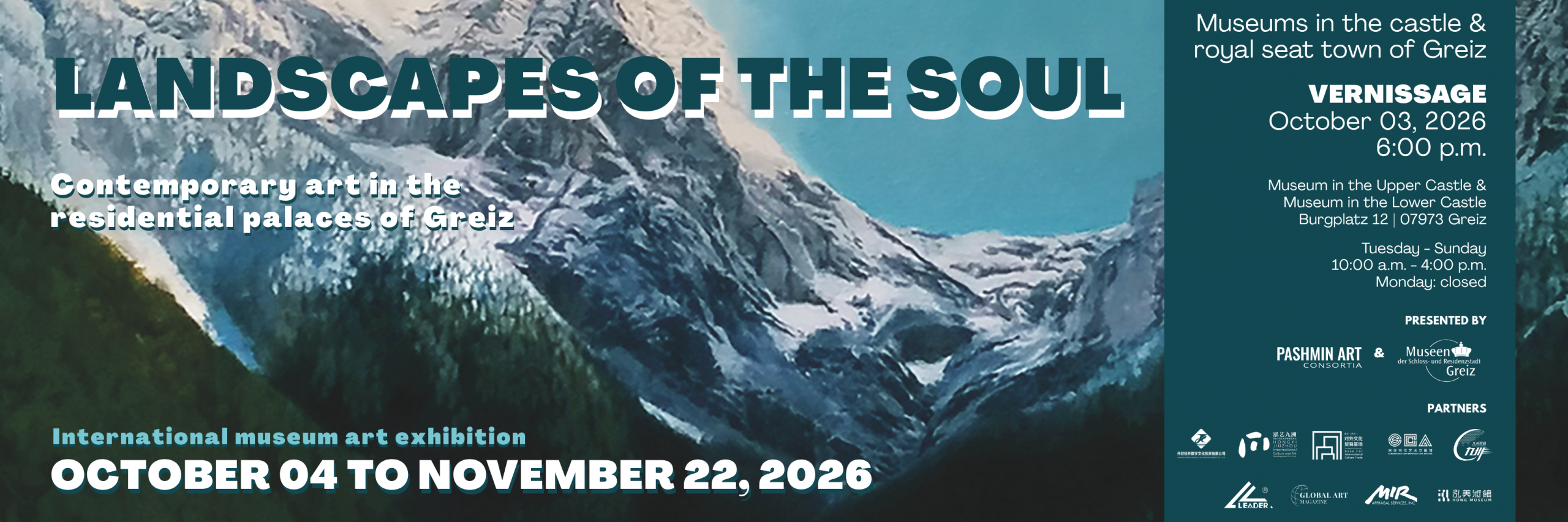
Landscapes of the Soul / Seelenlandschaften invites visitors not only to observe but to move between these different forms of inner and outer space. Perhaps the landscapes closest to us are not those that can be located on a map, but those formed through encounters, memories, losses, hopes, and transformations. The exhibition invites us to enter these territories: to look outward, to look inward, and to discover the shifting landscapes that emerge between the two.
About Pashmin Art Consortia
Pashmin Art Consortia is a leading international arts organization dedicated to promoting cultural exchange through art. With a global network of artists, galleries, and cultural institutions, Pashmin Art Consortia curates exhibitions and events that bridge cultural differences and bring diverse voices to the forefront of the art world.
About the museums of the castle and royal seat town of Greiz
The residential castles of Greiz, consisting of the Upper and Lower Castles, embody centuries of European architecture and history. The Upper Castle, whose origins date back to the 12th century, houses a museum that brings the region’s eventful history to life. The Lower Castle, a magnificent Baroque building, also houses a museum and a textile workshop that offers an insight into historical textile production.
The harmonious combination of the two castles forms a framework that unites architecture and cultural history. The interplay of the exhibition rooms unfolds a comprehensive picture of this rich historical era.